Gemstone Stories
Agate Meaning, Without the Mysticism
6 min read · Brownhaze studio, Los Angeles
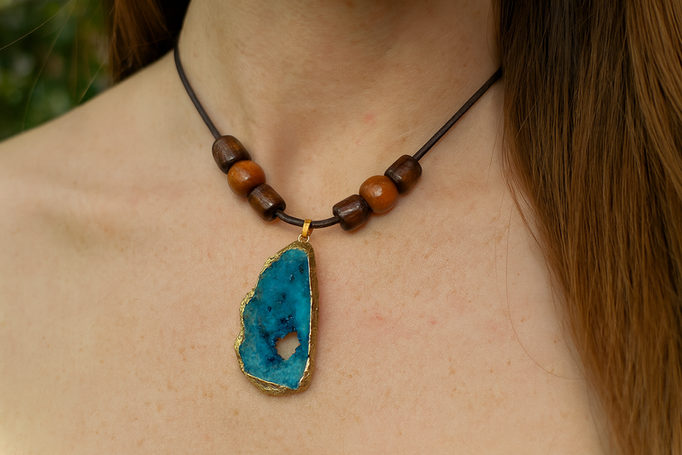
Agate is said to calm, ground and protect. Some of that is geology, some is folklore, and the honest version is more interesting than either. Here is what agate is, and where its meanings actually come from.
Search for the meaning of agate and you will find it described as a stone of calm, grounding and protection, usually without any explanation of where those ideas came from. Agate is interesting enough on its own terms. The honest version keeps the folklore but separates it from the geology.
What agate actually is
Agate is a form of chalcedony, which means microcrystalline quartz: quartz crystals too small to see, packed tightly together. It forms in cavities inside volcanic rock, where silica-rich water seeps in and deposits in layers, one after another, over thousands of years. Those layers are the bands.
On the Mohs hardness scale agate sits around 6.5 to 7, which is hard enough to take a high polish and to survive daily wear on a wrist or at a neckline. Its colours come from trace minerals picked up as it formed, most often iron and manganese, which is why the natural palette runs to cream, grey, brown, rust and moss rather than to bright primaries.
Where the name and the meanings came from
The name is usually traced to the Achates river in Sicily, where the stone was described by Theophrastus around 300 BCE. Agate has been carved ever since: into seals and signets, into cameos, into prayer beads, and into the flat banded cabochons that show its layers best.
The protective reputation is old and widespread. Banded stone was worn as an amulet, set into armour and carried as a talisman, and its layered structure was read as layers of defence. Much of the European trade in cut agate later centred on Idar-Oberstein in Germany, where local deposits and water power made it a cutting town from the sixteenth century onward.
What the traditions claim
In the language of the stone books, agate is called grounding, steadying and harmonising. The reasoning usually follows the stone: many bands of different colours sitting side by side, each one distinct, is read as a picture of separate things holding together.
We repeat those ideas because they are part of what the stone has meant to people for a very long time, not because we can demonstrate them. They are tradition and story, and they are worth knowing as exactly that.
What we can say plainly
We do not claim that agate heals anything, balances anything in the body, or changes what happens to the person wearing it. There is no mechanism for that, and a jeweller repeating it would not make it true.
What we can say is narrower and still worth something: agate is hard, comfortable and cool against the skin until it warms to you, it holds a polish, and no two pieces are alike because the bands were laid down by geology rather than by a machine. If wearing a particular stone makes you feel steadier, that is a real experience and it does not need a scientific explanation. It is the same way a favourite shirt changes a morning.
Choosing an agate piece honestly
Much of the agate sold today is dyed, and that is not automatically dishonest as long as the seller says so. Natural bands are irregular: they narrow, widen and sometimes pinch out, and the colour shifts are soft because they come from minerals. Dye tends to concentrate in cracks and along the channels in the stone, and a whole strand of identical, evenly saturated colour in a shade nature rarely produces usually means the stone was heated and treated.
Size matters as much as colour. Large polished slabs show the banding most dramatically and read as a statement on their own, while small beads give you texture and let you layer. Both are the same stone, doing different work.
- Ask whether the agate is natural, heated or dyed. A straight answer is the useful signal.
- Expect natural bands to be irregular in width and soft in colour.
- Treat bright, uniform, identical strands as enhanced unless told otherwise.
- Choose large slabs for a statement, small beads for layering.
- Agate tolerates water, but the cord or leather it is strung on may not: remove before swimming or showering.
- Store away from direct sun and wipe with a soft dry cloth.
Made by hand in Los Angeles
Every Brownhaze piece is designed and finished in our studio in small batches.
Shop agate jewelry