Two necklaces can look effortless or end up in a knot by dinner. The difference is length, weight and which strand you anchor. Here is the rule the studio uses when we style a layered neckline.
Layering two necklaces looks like an accident of good taste and is usually the opposite: the lengths were chosen, the weights balanced, and one strand was picked to stay put. The pieces rarely misbehave on their own. They tangle when two of them take up the same few inches of the body for the same few hours.
The two-inch rule
Give every strand its own arc. Two necklaces within an inch of each other sit on the same curve of the chest, so any movement slides one through the other. Separated by two inches or more, each hangs in its own zone and they barely touch.
In practice that means 16 in with 18 in, 18 in with 20 in, or 20 in with 24 in. A 16 in and a 17 in are a knot waiting to happen, even though they look like two different pieces on the table.
Anchor the shortest strand
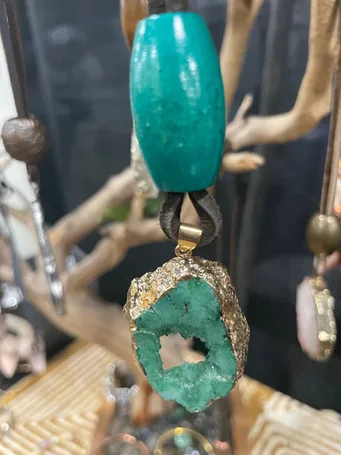
The shortest necklace moves least, so it should carry the most weight. A short strand of agate or tiger's eye sits high and steady against the collarbone, while a longer, lighter strand below has room to swing without dragging the first one with it.
Reverse that and you get the familiar problem: a heavy long strand swinging into a light short one, lifting it and letting it drop back. Weight belongs at the top of the stack.
Balance weight, not colour
Two delicate strands tangle more than a substantial one paired with a fine one. If both necklaces are built from 4 mm beads, choose one of them in a larger stone or a wider chain. The difference in mass is what keeps them apart, not the difference in hue.
Colour is the easy part. Stone, copper and recycled glass all sit in the same warm family, so an agate necklace beside a beaded strand rarely clashes. Aim for one dominant material and let the second echo it at a smaller scale.
When one big strand is the answer
A necklace built from large polished stones is already a whole outfit. Around 20 mm and up, the beads read from across the room and layering only muddles the line of the neckline. Wear it alone over a plain shirt, or with a fine chain dropped well below so the two never compete.
The same logic applies to a matched set. A necklace and bracelet set gives you the layered look without asking you to solve spacing, which is why it is the version we recommend when someone is buying for another person.
Storing them so they behave
Most tangling happens in a drawer, not on your neck. Strands stored in a pile work their way into each other and are then pulled apart, which is hard on the cord and on the clasp.
Hang necklaces separately where you can. In a jewellery box, lay each one flat in its own compartment, and when you travel, thread each strand through a short piece of drinking straw or coil it inside its own small pouch.
- Keep at least two inches between the lengths of any two necklaces worn together.
- Put the heaviest piece on the shortest strand.
- Pair one substantial necklace with one fine one rather than two of the same weight.
- Wear a large-stone strand alone, or with a fine chain far below it.
- Clasp every strand at the back so the fastening, not the beads, takes the tension.
- Store and travel each necklace separately, flat or hanging.
Made by hand in Los Angeles
Every Brownhaze piece is designed and finished in our studio in small batches.
Shop agate necklaces